telescopes
an instrument that collects electromagnetic radiation from the sky and concentrates it for better observation
Refracting Telescopes
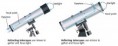
Telescopes that use lenses to gather and focus light are called refracting telescopes. A refracting telescope has an objective lens that bends light that passes through it and focuses the light to be magnified by an eyepiece. Refracting telescopes have two disadvantages. First, lenses focus different colors of light at slightly different distances, so images cannot be perfectly focused. Second, the size of a refracting telescope is also limited by the size of the objective lens. If the lens is too large, the glass sags under its own weight and images are distorted. These limitations are two reasons that most professional astronomers use reflecting telescopes.
Reflecting Telescopes
A telescope that uses a curved mirror to gather and focus light is called a reflecting telescope. Light enters the telescope and is reflected from a large, curved mirror to a flat mirror. The flat mirror focuses the image and reflects the light to be magnified by the eyepiece.
Large reflectig telescope
the lage telescope is controled by a computer and easy to take digital piture that are mor acurate than human drawing.
https://my.hrw.com/sh2/sh07_10/student/images/hst/obs/hst_obs_008_a.jpg
Optical Telescopes and the Atmosphere
they are also in space to avoide problems from our admosphear
Nonoptical Telescopes
study invisible radiation, scientists use nonoptical telescopes. Nonoptical telescopes detect radiation that cannot be seen by the human eye. Astronomers study the entire electromagnetic spectrum because each type of radiation reveals different clues about an object. Our galaxy looks very different when it is observed at various wavelengths. A different type of telescope was used to produce each image. The “cloud” that goes across the image is the Milky Way galaxy.
Radio Telescopes
Radio telescopes detect radio waves. Radio telescopes have to be much larger than optical telescopes because radio wavelengths are about 1 million times longer than optical wavelengths. Most radio radiation reaches the ground and can be detected both during the day and night. The surface of radio telescopes does not have to be as flawless as the lenses and mirrors of optical telescopes. In fact, the surface of a radio telescope does not have to be solid.
Nonoptical Telescopes in Space
Photo Gallery: telescopes